Some books I read:
1. The Absolutely True Diary of a Part-Time Indian by Sherman Alexie: This is a YA novel by one of my favorite authors about a nerdy Native kid leaving the reservation and going to a white kids' school in town. And it's kind of hilarious because the big fancy white kid school has like 200 students. That gave me some great flashbacks of high school. But it was very cute and sweet and enlightening. It's kind of a Young Adult, Native version of The Brief Wondrous Life of Oscar Wao. Highly recommended.
2. The Wife of Martin Guerre by Janet Lewis: I first read this when I was 15 or 16 and would stay summers with my aunt in Westchester, NY. My late uncle had worked for Scholastic (he invented the book fair; how bitchin' is that?) and my aunt still has a bunch of stock and gets crazy discounts. I think I read more real, good, modern literature on those trips than I ever have. It's a bit older, having been originally published in 1941, though you'd never know it. It's a really timeless book; it could've been written five years ago or two hundred years ago, a skill I envy. Martin Guerre is based on a true story of the life of Bertrande du Rols and her marriage to Guerre in the backdrop of 16th century France, during the rise of the Protestant Reformation. They are married off to each other in their early teens and, after the birth of their first child, Martin runs away from home for making an agricultural accounting error. He promises Bertrande he will come home in a few days or weeks. Instead he is gone for almost ten years before returning, Odysseus. Gradually Bertrande begins to suspect, in the coming years, that he is not her husband at all, but a stranger assuming Martin's identity. This book explores why it took Bertrande so long to come forward with her accusation (another child is born to her before she puts Martin on trial) and what, after so long, convinced her almost beyond doubt that he wasn't Martin. Even though she was also convinced that having slept side by side with a stranger for so long and never having come forward was a death sentence for him and a sentence to Hell for her.
3. The newest Sookie Stackhouse book, by Charlaine Harris: I do not remember this book's name, or what it is about. But I do remember that SPOILERS Sookie gets together with Eric, finally. So basically this book reminded me that Sookie has terrible taste in men. I liked Alcide the best. Also on the show True Blood he is handsome and looks like he is a musician in a band I would listen to. He would play the banjo, like the Avett Brothers. Why do I read this series?
4. 1491 by Charles C. Mann: A book about pre-Columbian Amerindian civilizations. A fairly peppy read, despite the kind of scary subject matter. It's in no way comprehensive, mostly concentrating on the big 3 of Meso and South American Indians: The Inca, the Mayans and the Aztecs (and even explaining why those names we learned for them growing up are all wrong.) But it contained some startling revelations, like the fact that when Pizarro and his men found Cuzco, they were most likely looking at the largest city they had ever seen, or that any European had seen. In the notes at the end of the book, Mann notes that it broke his heart to have to cut out a chapter on the American West, but he recommended a book called One Vast Winter Count, which I bought and am slowly chipping away it. It's...comprehensive.
5. Klondike: Phil Jourdan wrote this. It's funny. It's a noir detective story. It took me two sittings to read. It has a man named Hugo Slavia who is a surgeon and quotes philosophy. And a detective named Abe Klondike who is always suspecting that things are starting to become uncool.
In other news, I'm going back to Chicago again in about 10 days with the baby and his mother. I will probably spend too much money on books again, after I just recovered from all the damn crap I bought there in May.
Showing posts with label Western/Indian history. Show all posts
Showing posts with label Western/Indian history. Show all posts
Sunday, July 11, 2010

Friday, January 22, 2010
A dude I love: Sherman Alexie
When I was in high school, my friend Will gave me a book that I've since grown to love, called Reservation Blues. The motivation was, I think, that I had given him a mix CD with a Robert Johnson song on it. Reservation Blues is the story of a couple of down-and-out Spokane reservation Indians who receive a magical guitar from Robert Johnson and form a blues band. They travel around the Pacific Northwest and learn, you know, stuff about life.
I immediately loved Sherman Alexie, both for his work and his amazingly outspoken public persona. His book of short stories, Ten Little Indians, is also one of my favorites, and my mother has spoken highly of his young adult novel The Absolutely True Diary of a Part-Time Indian.
Alexie keeps a pretty cool website, www.shermanalexie.com, which contains his blog and some general biographical info.
He made news recently for denouncing digital versions of books, as you can see in this clip of him on the Colbert Report:
http://www.colbertnation.com/the-colbert-report-videos/257719/december-01-2009/sherman-alexie
...where he says that none of his books are available for digital download. He points out, and rightly so, that we should all be paranoid of having our entire lives (like text messages, what we're reading, who our friends are, etc) all on one device that anyone with half a brain could hack. "I'm an Indian. I have plenty of reasons to fear the government."
Alexie also apparently is a great public speaker, and I'd like to see him in person someday. His speeches are a combination of stand-up, social commentary, and literary critcism. Speaking at Cornell last year, he spoke about the unacknowledged genocide of American Indians. "He demanded an acknowledgment of the genocide that wiped out entire tribes of people. 'Where is our roomful of moccasins?' asked Alexie, referring to the Holocaust Museum’s powerful room full of shoes that illustrates the thousands of lives lost in Nazi extermination camps."
http://www.indiancountrytoday.com/archive/41972527.html <<--Full article here
More than anything, Alexie writes eloquently about poverty, isolation, ruralism, and post 9/11 attitudes towards "brown people" that few other American others could ever hope to touch.
He's a cool dude. Everyone should read his stuff.
I immediately loved Sherman Alexie, both for his work and his amazingly outspoken public persona. His book of short stories, Ten Little Indians, is also one of my favorites, and my mother has spoken highly of his young adult novel The Absolutely True Diary of a Part-Time Indian.
Alexie keeps a pretty cool website, www.shermanalexie.com, which contains his blog and some general biographical info.
He made news recently for denouncing digital versions of books, as you can see in this clip of him on the Colbert Report:
http://www.colbertnation.com/the-colbert-report-videos/257719/december-01-2009/sherman-alexie
...where he says that none of his books are available for digital download. He points out, and rightly so, that we should all be paranoid of having our entire lives (like text messages, what we're reading, who our friends are, etc) all on one device that anyone with half a brain could hack. "I'm an Indian. I have plenty of reasons to fear the government."
Alexie also apparently is a great public speaker, and I'd like to see him in person someday. His speeches are a combination of stand-up, social commentary, and literary critcism. Speaking at Cornell last year, he spoke about the unacknowledged genocide of American Indians. "He demanded an acknowledgment of the genocide that wiped out entire tribes of people. 'Where is our roomful of moccasins?' asked Alexie, referring to the Holocaust Museum’s powerful room full of shoes that illustrates the thousands of lives lost in Nazi extermination camps."
http://www.indiancountrytoday.com/archive/41972527.html <<--Full article here
More than anything, Alexie writes eloquently about poverty, isolation, ruralism, and post 9/11 attitudes towards "brown people" that few other American others could ever hope to touch.
He's a cool dude. Everyone should read his stuff.
Thursday, January 21, 2010
Webster v. Fahey: Revisionist History

This entry is only passingly about books, and contains a LOT of pedantic information about my city. Read at your own risk.
So as I've mentioned before in previous spaces, my friend Dusty just opened an art/mixed media gallery in North downtown Omaha (idiotically known as NoDo). I spend a lot of time in this part of town, as Saddle Creek Records has a complex on the next block that includes an art house theater, an awesome bar, and a coffee shop that I love. Formerly, both Axiom and the Saddle Creek Complex were located on Webster Street, about 20 blocks from my abode. They are now located on Mike Fahey Drive.
In our part of town, most of the streets are named for important early Omahans, Nebraskans, or heroes of the Civil and Plains Indians wars. Running south to north, in what I consider my general neighborhood, the streets go Dodge (named for Grenham Dodge, a Civil War general), Davenport (I admit I don't know what this is named for, though I presume it's the same thing/person as the town of Davenport, NE), Chicago (self-explanatory), Cass (another Civil War general, and also the street I live on), California (see "Chicago", above), Webster (see below), Burt (named for our first territorial governor), and Cuming (another Civil War soldier).
As you can see, there's a somewhat common theme for the streets in this part of the city, which dates back to around the turn of the 20th century.
I'm upset about the name change from Webster to Mike Fahey. Really upset. Not like, throwing things upset, but upset enough to complain about it at parties to Dusty and write blog entries about it. And here's why!
John L. Webster was, in the 1870's, the lead attorney for Union-Pacific railroad, which was a gigantic corporation--the importance of the railroads in forming this part of the world really can't be understated. It was a big-ass fancy job. In 1876, he worked pro bono in a landmark civil rights case, Standing Bear v. Crook. He was on the side of Standing Bear.
You might remember Standing Bear from your American history class, but you probably don't. A brief rundown: Standing Bear was a member of the Ponca tribe, which was a non-nomadic tribe living in Northeast Nebraska (near the present day NE-SD border, on the banks of the Niobrara River). During the time period when the US government thought it was fun to fuck with Indians for no particular reason, the Poncas were rounded up and forced to march to Indian Territory (present day Oklahoma) in what's now know as the "Ponca Trail of Tears." While in OK, Standing Bear's son died, and his deathbed wish was to be buried at home on the Niobrara. So Standing Bear and his family turned around and marched all the way back home, a distance that's about 12 hours by car, in the dead of winter. They made it about as far as Omaha before Standing Bear was arrested and thrown into jail at Fort Omaha by General George Crook. Standing Bear sued Crook for rights of habeas corpus, i.e. that he was unlawfully detained, both by being confined to a reservation, and in the prison. He won his case, in no small part because of the awesomeness of his attorneys, John Webster and Andrew Poppleton (which is the name of the last street I lived on!) And in so winning, he was declared a human being by the Nebraska court system.
Obviously, this is a pretty big deal. It's considered one of the most important court cases in American Indian history, which you can imagine has seen a whole hell of a lot of court cases. And it's also very important for civil rights for all American citizens, in that it reaffirms that you can't be randomly thrown into prison or confined to a landed space, like an Indian reservation, without just cause.
This is all laid out beautifully and intricately in a wonderful book called "I Am a Man" by Joe Starita. The title is taken from Standing Bear's speech during the trial, as translated by Susette "Bright Eyes" LaFlesche:
"My hand is not the color of yours, but if I pierce it, I shall feel pain. If you pierce your hand, you also feel pain. The blood that will flow from mine will be the same color as yours. I am a man. The same God made us both."
I saw this man speak last winter in the home of General Crook, which is now a museum at Fort Omaha. Terrific topic. Terrific book. Required reading for anyone interested in Plains Indian history or minority rights.
The story ends very sadly: Standing Bear's brother Big Snake was later killed by soldiers for attempting to make the same journey home, and in the 1960's, the Ponca tribe was dissolved by the federal government, and the reservation sold off to farmers. They were reinstated about 10 years ago, but the damage that the dissolution did will probably never be fully healed.
Mike Fahey was the mayor of Omaha from 2001-2009. He was born in KC and attended college at Creighton University. He gained prominence in the city by starting an insurance company. He gained notoriety for the following:
1. Quote wikipedia: "In October 2006 the City of Omaha Safety Auditor Tristan Bonn submitted a report which detailed Omaha Police Department officers' aggressive, rude and unwarranted traffic stops, which unprecedentedly involved African Americans and other people of color.[2] Within a week Fahey fired her, as he called Bonn "insubordinate" for submitting the report.[3] The incident has caused ire within North Omaha [i.e. the black part of town] particularly.
2. "Fahey has been criticized for his decision to build a new baseball stadium in downtown Omaha as a means to securing a long-term contract with the NCAA to keep the College World Series in Omaha. As a result of this, a group of Omaha residents circulated a proposal to recall Fahey. This petition drive failed, with the Recall Fahey campaign collecting only 8,202 of the required 21,734 signatures."
GUESS WHERE THIS BASEBALL STADIUM IS LOCATED. OH RIGHT, ON WEBSTER STREET, right behind the Saddle Creek complex. It's under construction as I write this, and is currently in the spooky rebar skeleton stage.
It's also been alleged that part of the reason Fahey wanted the stadium in that part of town (which is undergoing a swift gentrification process) was because he himself had bought up a fuckton of land by the river, and then resold it to the city, making an absolute killing. This is all common knowledge for the citizens of Omaha.
A link from the Omaha World-Herald about the street name change:
http://www.omaha.com/article/20100118/NEWS01/701189954
So tell me. Which one of these men deserves to have a street named after him?
Wednesday, January 20, 2010
Books on my shelf that I haven't read/haven't finished:
This list does not include reference books, my Bible, textbooks, or any book that isn't meant to be read comprehensively. I've also included a short note on why I bought the book, or what it's about, or some junk like that, where applicable.
1. Don't Look Now--Daphne du Maurier. Rebecca is one of my favorite books ever. This was a by the lb blind buy. I didn't even bother to read the book flap.
2. Douglas Adam's Starship Titanic--Terry Jones
3. Gods, Demons, and Others--compiled by R.K. Narayan. The blurb on the front of this book says, "Great tales from Indian myth and legend retold in English by India's leading novelist." I pulled this book out of the trash can when we moved into our current abode, along with an INSCRIBED copy of Franny and Zooey. Whomever lived here before us is a heartless bastard.
4. Montana, 1949--Larry Watson. I bought this because the cover and the blurb reminded me of an Annie Proulx book.
5. The Metaphysics of St. Thomas Aquinas--translated by James F. Anderson. I took a class on early church literature while I was at UNL and it was very interesting. I wish I'd paid more attention but I was busy drinking a lot, which leads to a somewhat gappy memory. This is another book I pulled out of the trash. Its previous owner seems to be "Mary Jeannette Dorcey," who lived in Apt. 23 and bought it for $2.
6. The Seven-Per-Cent Solution--by John H. Watson, M.D., ed. Nicholas Meyer. Glorified fan fiction. I don't anticipate liking this book. YOU DON'T FUCK WITH CANON.
7. Eleanor Rigby--Douglas Coupland
8. Adverbs--Daniel "Lemony Snicket" Handler. I started this book in high school and remember liking it, but it was overdue at the library or something.
9. Fathers and Sons--Ivan Turgenev. My roommate's boyfriend left it here and said I could keep it.
10. All Quiet on the Western Front--Erich Maria Remarque
11. Voices of a People's History--comp. Howard Zinn and Anthony Arnove. A companion piece to one of my favorite books, A People's History of the United States by Zinn, and apparently a documentary called "The People Speak." This was a Christmas present from my friend Lia, along with Breaking Dawn. Hell yes.
12. Black Elk Speaks--John G. Neihardt
13. The Road to Wounded Knee--Robert Burnette and John Koster. This has "flavor of the month" written all over it, but it looks pretty interesting. Also Koster's interests apparently include "history of the West and parapsychology." I wonder if he does ghost town excursions.
14. Lewis and Clark Among the Indians--James P. Ronda
15. Black Hills, White Justice--Edward Lazarus. This is about Sioux Nation v. the United States, one of the biggest (if not THE biggest?) settlements against the US ever brought about by the Supreme Court. I read about 3/4 of this and then got bogged down in somewhat tedious legalese. I know how it ends, anyway.
16. Indian Fights and Fighters--Cyrus Townsend Brady. Both the title and the author of this book are very catchy.
17. Custer Died for Your Sins: An Indian Manifesto--Vine DeLoria Jr.
18. Born Rich: A Historical Book of Omaha--Margaret Patricia Killian. I bought this at a book sale at a synagogue, which are seriously the best book sales. Go to one, if you get the chance. It's some woman's recollections about being wealthy at the time Omaha was founded as a dirty little river town. It also kind of looks like someone spilled mashed potatoes on the cover.
19. The Authentic Life of Billy the Kid--Pat F. Garrett. The tagline is "A faithful and interesting narrative by Garrett, sheriff of Lincoln Co., N.M., by whom he was finally hunted down & captured by killing him." Leaving aside the obvious syntax problems, this is what we learned in school is called an "unreliable narrator."
20. The Stranger--Albert Camus. I don't remember why I never finished this. It turns out that angst and despair are kind of boring.
21. "The Possessed"--Albert Camus
22. Steppenwolf--Hermann Hesse
23. Gone Baby Gone--Dennis Lehane
24. King Solomon's Mines--H. Rider Haggard. I bought this solely because I'm gay for Alan Moore's League of Extraordinary Gentlemen. Don't judge me. At least not for this.
25. The Plot--Irving Wallace. Again, book by the lb, no idea what this was about. But The People's Almanac was a perennial favorite of mine and my brother's when we were children. It was snappy, weird, and informative.
26. Utopia--Thomas More. Trashcan book.
27. A Death in the Family--James Agee
28. Vanity Fair--William Makepeace Thackeray. I might have actually read this in high school; I didn't have a life in HS so all I did was read classic European novels. But I might be confusing it with "Pilgrim's Progress", which I also sometimes get confused with "Childe Harold's Pilgrimage."
29. The Story of the Western Railroads--Robert Edgar Riegel. Hahah why did I buy this. It's like something an autistic kid would own.
30. The Reader--Bernhard Schlink. I also own the movie of this, and I've read the first 20 pages, so I sometimes lie and tell peole that I've read this book. I have not. It feels nice to get that off my chest.
31. A Moveable Feast--Ernest Hemingway
32. For Whom the Bell Tolls--Hemingway
33. The Autumn of the Patriarch--Gabriel Garcia Marquez. I think I bought this at the same time as 100 Years of Solitude but was so scarred by the former that I never gave this one a shot.
34. Empire--Gore Vidal
35. Speaker for the Dead--Earlier in the year I was attempting to mack on a boy whose favorite book was Ender's Game. My friend Alecia gave me both books. The macking subsequently failed and, never having been a huge fan of sci-fi, I gve up on this book about 1/3 of the way through.
36. The Thirty-Nine Steps--Abandoned by the roommate's boyfriend, again.
37. Tender is the Night--F. Scott Fitzgerald. I might have actually read this. But all Fitzgerald's books tend to bleed together in my brain.
38. A Connecticut Yankee in King Arthur's Court--Mark Twain. Trashcan book.
39. Empire of the Sun--J.G. Ballard. I remember this moving being awesome/frightening.
40. The French Revolution--Thomas Carlyle. I want to read this but I'm scared of it. It's over 500 pages long.
41. The Return of the Native--Thomas Hardy
42. "The Cherry Orchard," "The Sea Gull," "The Three Sisters," "Uncle Vanya."--Anton Chekov. I think I've seen a stage version of "Uncle Vanya" but I've never read any of these.
43. Postcards--Annie Proulx. Love her. Love you. Probably will love this, once I get around to reading it.
44. The French and Indian War--Francis Russell. This is the type of book that uses the word "savages." Enough said.
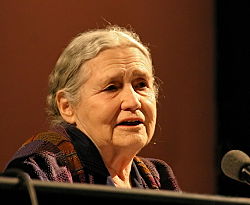
45. The Golden Notebook--Doris Lessing. My brother gave me this for Christmas. Also, Doris Lessing kind of looks like Golda Meier. Check it out:

Subscribe to:
Posts (Atom)